
[00:00:12] Barry O’Kane: Welcome back to HappyPorch Radio, the Circular Economy Technology Podcast.
I'm Barry O’Kane, and this is Season 10 titled “Technology Isn't Magic” where we are exploring what actually happens when circular economy technology meets the messy reality of real business and real people.
My guest today is David Watson, founder of Circular Connect and Chief Client Officer for RL People and RL Equity.
David has been working in the circular economy for many years across recruitment, mergers and acquisitions, and now media and community.
Circular Connect started in February 2025 as a newsletter born from the straightforward frustration - A lot is happening in the circular economy, but it is genuinely difficult to find. And within months the newsletter was monetizing, and by January 2026, the directory went live.
In the interest of full transparency, HappyPorch built that directory. So you're hearing this from an interested party, but that shared history is exactly why I wanted David on the show. And that's because what I find most interesting about Circular Connect is not the technology. It is what David describes as digitizing the whole ethos of networking, making the connections that happen brilliantly at conferences and then go quiet for 12 months consistent and searchable.
We also get into where circular M&A activity is hottest right now and what it will actually take to move this industry at scale.
As always, full transcript and links at happyporchradio.com.
So let's meet David.
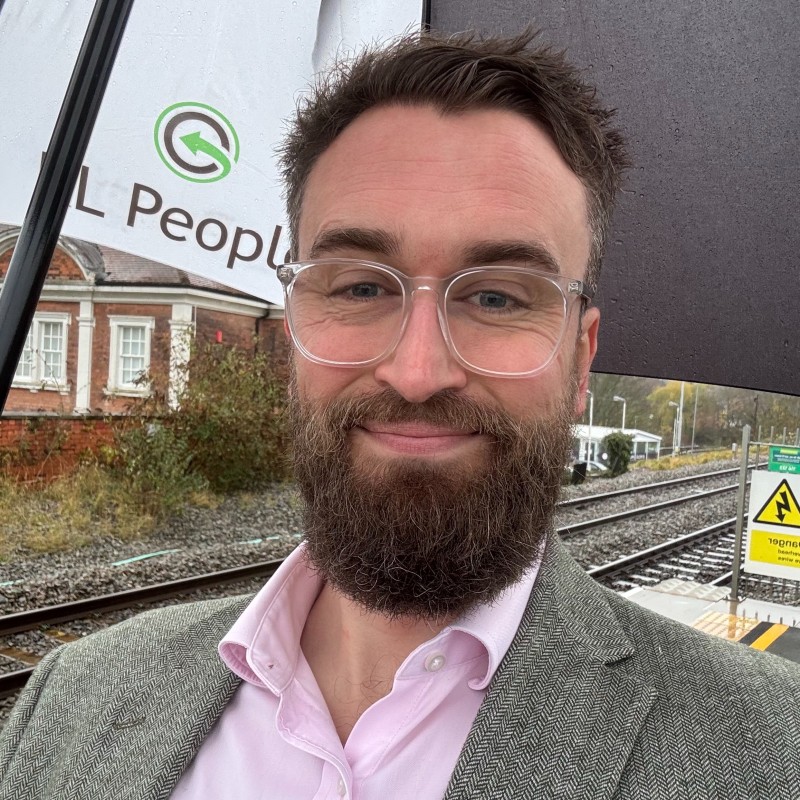
[00:01:39] David Watson: Hi there. This is David Watson, founder of Circular Connect and Chief Client Officer for both RL People and RL Equity.
[00:01:47] Barry O'Kane: Excellent and welcome to HappyPorch Radio. Thanks for coming along.
[00:01:50] David Watson: Thanks for having me.
[00:01:51] Barry O'Kane: So I'm really excited talking about Circular Connect and also in the context of these other amazing businesses that you're involved in. Partly because you and I have worked together on Circular Connect. So let's talk a little bit about what exactly Circular Connect is and how it grew to where you are now.
[00:02:06] David Watson: Perfect. I will start at the beginning. So Circular Connect started life as a newsletter back in February, 2025. And it was born out of a frustration. I've been in the circular economy for coming up to 10 years now. I have my finger on the pulse of what's happening and fundamentally, it is a fascinating industry with a lot of good stuff happening, but it's really difficult to find all of the good stuff happening. So I decided to create a forum whereby I was sharing weekly news updates, global news updates with an audience. And honestly it was launched with no desire to turn it into a business. It was launched very much as a passion project. Something to just do basically.
But it quickly picked up pace. So much so that we were able to invite sponsors into the newsletter platform and monetize it. About six months before the newsletter was launched I had an idea of creating a directory for circularity businesses. But I wasn't able to launch that in standalone. Essentially you need an audience, you need a bit of a following. So the newsletter growing as it did and being able to monetize it, enabled us to think far more proactively about launching a directory, which led to our discussion, Barry which furthermore led to the Circular Connect directory being created.
So these days we are a directory, first and foremost with the newsletter, empowering that, and it's a really nice closed loop ecosystem of basically media services and promotional campaigns. Launched in January, 2026. So we're a couple of months into this journey.
[00:03:36] Barry O'Kane: Awesome. Awesome. So tell me a little bit about, when you say directory, who's it for? What does it list? What is going on in the directory itself?
[00:03:43] David Watson: Essentially it is a one-stop shop for any organisation that is either involved in or offering a circular solution. So this could be circular service providers. This could be brands, it could be retailers, it could be OEMs.
Essentially we do not plan on slowing down with integrating and uploading organisations into the directory until it is feeding itself as a standalone platform. So anyone who's involved in circularity in some way or another has a place within the platform.
[00:04:10] Barry O'Kane: And that's a really broad definition. And one of the things I often struggle with is, I describe circular economy as this umbrella term, which covers so many different things. It's not like it's a specific industry or a specific thing.
What's your definition when you say everyone that's involved in circularity? Do you have a clear definition on that or does it flex?
[00:04:28] David Watson: I always look at this from an operational standpoint and I have done ever since we started supporting the industry. So my definition of circularity is ultimately operational after sales processes. So asset repair, asset recovery, repair, refurbishment, I dare say it, but recycling, commerce resale, and so on and so forth.
There's a broader circular segment as well. The legislative and the I guess somewhat more theoretical side of things. That's the element of circularity that I'm not actively involved in. I'm looking at this from a pure play business, operational standpoint.
[00:05:02] Barry O'Kane: Yeah, that makes a lot of sense too.
So then just stepping back a little bit as you said you have 10 years working with RL people and RL Equity, which we can talk about in a moment. And then you felt like there was a gap or these things are happening in isolation. I'm not sure exactly what the term you used, and you thought, okay, what about a directory, what about a newsletter? I wanna dig into that a little bit more. Is that driven by a, “Oh, I really care, I'm really passionate about this space.” Was it driven by something else?
[00:05:27] David Watson: Excellent question. So through all of the businesses that I'm involved in I spend a lot of time networking and going to conferences and meeting with people, and I absolutely love it. But one of my major frustrations with networking at conferences is in the heat of the moment. Conversations are incredible. Connectivity is incredible. You come away with a sense of, Yep, we really shifted the needle for our business. And then there's silence for 12 months until the next networking event. So the fundamental reason why I've done this, is to try and digitise the whole ethos of networking and make it constant.
So if you want to go and find a potential partner, a potential provider you want to go and win some business, you go to Circular Connect to do it. And ultimately every single circular business out there is looking to win more work and be more visible. But it's really difficult to do because circularity as an umbrella and the language within it is incredibly nuanced.
[00:06:23] Barry O'Kane: That is really relevant to the theme of this season of the podcast. Obviously HappyPorch Radio is looking at circularity through the technology lens and the enabling role that technology plays.
But we can't look at that in isolation and that's really one of the things that I'm fascinated about, what you described there with Circular Connect, "digitisation" you used that term, but it's really about the human connection.
Is that fair? And what are the tensions in that?
[00:06:45] David Watson: The human element to circularity is fundamental to growth. Yes, technology is important. Digitisation is important. Artificial intelligence to enhance operational efficiencies are incredibly important from a circularity standpoint. But this industry is only going to grow and grow properly through properly robust strategic partnerships.
And what are robust strategic partnerships ultimately led by? Humans. It's the same across Circular Connect. It's the same across RL People, and it's the same across RL Equity. The success of all three of those businesses is built on human connection.
Now, where technology becomes important is optimising and enhancing the ability to connect with other humans. But the human bit is always there and it's fundamental. So what we try and do across all of our businesses is reduce connectivity, friction, make individuals and organisations more accessible and drive good stuff out the back of it.
[00:07:40] Barry O'Kane: Yeah. So let's explore a little bit about those other elements of your business ecosystem. Tell me a little bit about RL People and RL Equity.
[00:07:49] David Watson: Perfect. RL People is a recruitment business. We were founded back in 2017 at the time to service the operational reverse supply chain. So repair, refurbishment and ultimately resale. This was before circularity and the circular economy became a big thing. As years have passed and as the industry has evolved, as have we and now we're a fully fledged circular recruitment business, helping organisations globally with hiring industry and adjacent industry professionals, and the adjacent industry piece is really important because there's only a finite number of us working in circularity these days, but the industry is growing rapidly. So we need to be looking at adjacent industries and convincing people to come and join us in this wonderful world. So that's RL people. So that was 2017.
Fast forward to 2024 and we founded RL Equity which sits in the RL portfolio. And that is ultimately a business brokerage. So we support with M&A activity on both the buy side and the sell side. And the reason why we launched that alongside RL people was we saw the trends emerging of heightened institutional investor interest in the space. There was some fairly significant M&A deals taking place and we kept getting asked. We kept getting asked by our network: Who is for sale? Who is buying? How do I extract as much value as possible out of my creation? So it made sense to commercialise the service.
So essentially I now look at the industry and I engage in discussions with the industry through three different topics, which is people first and foremost, M&A and inorganic growth and then media and sales and growth and connectivity.
[00:09:28] Barry O'Kane: Yeah, just to go back to the RL People first. And you described the adjacent industries and that being because of the growth of circularity and reverse and sort of the skill sets and so on needed there. But what do you mean by adjacent? Can you give that a bit more flesh?
[00:09:45] David Watson: Absolutely. So we are seeing a lot of success at the moment in speaking with individuals who have pursued careers in normal technology. So if I'm to look at services or product sales, usually in the new segment. Now there's plenty of refurbishment businesses out there and organisations that are offering high volume after market service solutions who are willing to engage with individuals who have sold new products, but have an appetite to jump into the secondary market and make a difference there.
So adjacency for us is same product, not refurbished, or similar markets. So anything where you are servicing a technology environment, a data center, high tech environments, financial services environments, with some form of managed service. You can jump into a circular environment and do very well.
[00:10:38] Barry O'Kane: And that's really interesting because one of the things that I see or people ask me is when, maybe driven from a values point of view or a sustainability point of view there, how do I get involved in circularity? So that's a really interesting thread that you've picked up there that ask how transferable skill sets are really.
[00:10:53] David Watson: They are, they fundamentally are, but we make it very difficult for ourselves to transfer other skill sets into circularity because there's a lot of hiring organisations out there that are still dead set on, we need experience within a competitor.
I think another issue is just a lack of comprehension on what circularity is from the average consumer. And this is a massive gap in the market as well, which is unless you are involved in this space, you have no idea it exists. Now you touch it, you return something. But what you don't understand is that there is an organisation empowering that return and processing that return in the background hundreds of thousands of times a day. So another channel and we can talk about the Circular Connect, I guess product map moving forwards, because there's a couple of ideas that I'd love to articulate. But another channel to Circular Connect is just amplifying what circularity is to everyone, not just the industry, but to the wider world, because I think that's incredibly important.
Because it's honestly fascinating. And average consumers find it fascinating once they understand about the true scale of it and what actually happens within it.
[00:11:57] Barry O'Kane: Yeah. Yeah. Fascinating is a really good word, I think, because as you say, if I say circular economy to people who haven't been exposed it's a terminology that maybe they haven't heard or don't get. But there's an element of common sense in the practical, like this is when a product moves around and I return it, or I resell it, it needs repaired or whatever. But what's fascinating is the detail in that and the subtle differences and for me, that's the fascination part.
Is that what you mean?
[00:12:21] David Watson: Absolutely. And I think again, from an operational standpoint, I and others that I speak with, just find the whole concept of repairing stuff and then repurposing it really cool. And simply fascinating. And the commercial value add to consumers that circularity brings is significant.
But again, it all comes down to education. Does everyone know that you can go and buy a refurbished laptop that is just as good as new, comes with 24 months warranty, and is 40% less than list price? Does everyone know that? No, of course they don't. So I feel like it's our collective mission, but also Circular Connect's mission to make that kind of information and ultimately education more accessible.
[00:13:03] Barry O'Kane: Yeah, and as you said let's explore that and your sort of future vision for Circular Connect. But just before doing that, I wanted to quickly go into a little bit more depth on RL Equity as well.
Is that a slightly different audience and in terms of the sort of businesses you're looking at, or is it broadly the same kind of sector or types of businesses that RL People serves and that you're looking to serve with Circular Connect?
[00:13:25] David Watson: It's very similar. But we see hotspots of activity from an M&A standpoint. So at the moment we're seeing a lot of activity in the hardware decommissioning landscape which is linked to AI. So data centers and hyperscalers are having to grow and evolve at a pace that has never been seen before, just to keep up with the growth in AI technologies which is cool. And there's an NVIDIA conference at the moment in California where everyone's talking about this stuff, but what that leaves behind is a trail of technology that is still perfectly usable in less intense technology, hyperscaler type environments, but decommissioning it properly, recommissioning it properly and ensuring maximum value recovery is tricky. But there is a selection of service providers out there that are able to do that and do that consistently.
So we are seeing massive M&A interest and private equity interest in that space right now because that's not gonna slow down anytime soon. And again, from a circular standpoint, it is recovering an asset that still has value, making sure that value is realised, and then passing it on to a new owner who can consistently use it.
So that's really busy for us right now. But yeah the markets are ultimately very similar. A lot of tech, we're seeing a lot of growth in the whole fashion and commerce space as well from an M&A standpoint, which is pretty cool.
[00:14:48] Barry O'Kane: Yeah, that is really interesting. And then just before we get back to Circular Connect, which we're supposed to be talking about, you've touched on one on a couple of examples there from a some M&A and a business point of view where the hotspots are, but from a digital and a software point of view, both from skill sets, maybe somebody listening who's got a skillset and is looking for opportunities or a business who's thinking about where to focus their energy for opportunities are, where are you seeing the opportunities or the biggest movement there.
[00:15:15] David Watson: Traceability.
So we're in an age where product is dispersed globally and it's incredibly difficult to know where your assets are. Certainly in multi-site, high volume environments, we have seen a significant amount of growth in traceability software recently. And then to layer on top of that, the whole Digital Product Passport piece, DPP, legislative requirements specifically in Europe are starting to mandate that products will have DPPs but we don't necessarily have the software infrastructure in place yet in order to enable that. So organisations are working really hard to A, try and figure this stuff out and then B, to make sure that it's implemented.
So again, from a software technology standpoint, asset tracking and traceability and digital product passports are really hot areas right now.
[00:16:02] Barry O'Kane: Yeah, that makes a lot of sense. And that makes me think of another question. In circularity generally, how much is driven by, do you think policy that then brings investment and opportunities versus maybe a sustainability agenda or the economic agenda? Because it can be complicated, often you're pushing against a sort of linear headwind, “this is the way it's always been done” kind of mentality.
[00:16:26] David Watson: Policy is paramount to driving change at scale. It's either ultimately gonna be policy or commercial. Unfortunately the sustainability agenda had its importance and look, it still is categorically important, but what makes corporations listen and what makes corporations willing to change? Top line and bottom line impact. And ultimately being told that they have to by legislative changes. I wish it was different, but I can't see that changing anytime soon.
[00:16:54] Barry O'Kane: Yeah, that's interesting. And that for me is actually one of the exciting opportunities from genuine understanding about circularity because you've got the opportunity to align those incentives. Keeping an asset in use when it's done well has a big sustainability benefit and an economic benefit.
[00:17:09] David Watson: It absolutely does. When you look at it from a distribution or new sales standpoint, three or four years ago, OEMs were absolutely dead set against circularity. “Now, it would cannibalize our new sales. It would impact our ability to just keep selling our products.”
Fast forward three to four years and OEMs are starting to embrace refurbished channels, either in-house or outsourced with a specific provider. But they're doing it and the reason why they're doing it is because they are seeing it as a customer acquisition process. So you sell a new product to one customer previously, an OEM, that was it. Done. But then if you have the capability to bring that product back from consumer number one, and then sell it to consumer number two, and then consumer number three, and then consumer number four, you have four customers with one product as opposed to one customer with one product.
So it's starting to shift. There are still massive barriers and there is still a reluctance to properly engage, refurbished in circular channels, but it's getting better and then it will continue to get better.
[00:18:11] Barry O'Kane: And when you say reluctance, do you mean from a sort of consumer point of view? I want to own the shiny new thing, or from a business point of view.
[00:18:18] David Watson: Business point of view. Yeah. Consumer behavior has evolved significantly when it comes to the secondary market and refurbished products. And that's primarily been driven by cost of living crises and the fact that buying a new iPhone for 1400 quid isn't justifiable anymore, but you can go and buy an iPhone 13 for 700 quid and it's as good as new and will last you two years.
So the consumer receptivity to the industry is definitely getting better. A lot better. But again, that could be accelerated through education. And just visibility of what this all entails.
The primary reluctance still sits on the business side of things because, and I think that boils down to we have always done it this way. It will cannibalize sales and it's just a big change to mentality, which a lot of businesses are wary of.
[00:19:08] Barry O'Kane: Yeah. It's very easy for me to characterise that as a “We don't want to do this” but I think often it's a “That would be nice, but I'm busy doing my job. How do I make a change of that sort of scale?”.
Which takes us back to Circular Connect. And software generally, because one of the things that, I assume, that you're interested in there is enabling these businesses both to scale and to share their services and make the connections that allows them to go to the place that's struggling. To implement this, to say “I can help, I can solve some of those problems.”
[00:19:39] David Watson: One hundred percent. Because if you look at an OEM, to your point the biggest barrier to entry for circularity is the change and the time that has to be invested in enabling that change. But there are now plenty of as-a-service circular providers out there that can do it all for you. And that's exactly what we want to achieve with Circular Connect is surfacing these as-a-service providers and then allowing OEMs and brands and retailers to connect with them and essentially accelerate circularity. That's the dream.
[00:20:14] Barry O'Kane: And let's explore that in two ways. First, where is it now? You said you have the newsletter you've been running for a little while. How big are things right now?
And then second question, you also mentioned before you've got some of these ideas and visions of where you'd like to go?
[00:20:27] David Watson: So the newsletter, we're approaching 2,500 subscribers and we're adding roughly a hundred a month at the moment. It did plateau slightly at the beginning of the year as we focused on the directory rollout. But things are starting to pick up again, which is excellent. We are targeting 4,000 subscribers this year, so a bit of a way to go.
But what we are finding is now that the directory is generating some healthy traffic through SEO, that's been driving subscribers to the newsletter as well. So both sides of the business are starting to feed each other, which is really cool. Now in terms of where we want to go, there are so many opportunities for connectivity within this space. It is still inherently disjointed.
So newsletter, directory, what we have ultimately created is a platform that is starting to generate a ton of data. And the data is essentially linked to, “What services are in high demand? Where is the demand sitting globally?” So all of this enables us to essentially see where the market is moving at scale. That in itself is incredibly important. So I think this is a 2027 roadmap product idea, but the data analytics within the platform and creating reports that can then be distributed back into the industry to allow people to know what is happening will be an incredibly useful tool coming out the backend of the system.
There's also a conference and getting people together in person. The very nature of Circular Connect is to connect people in circularity. But we don't just want to do that all online. We are massively, massively pro-networking and face-to-face interaction, and we've hosted a couple of small get-togethers over the past couple of years, which have always been brilliant. People get together, have a good time, there's no agenda. But then the business happens two months, three months, four months down the line. So we want to keep doing that. We're considering more of a formal conference or certainly collaborating with a couple of our partners to create a conference that pulls together individuals from every single part of the value chain.
And what I mean by that is product agnostic, service providers and ultimately service procurers all in the same room, trying to figure out operational circularity at scale. So for circularity as it relates to business how do we maintain profitability? How do we maintain or enable implementation? And then how do we scale this? I think that's an incredibly important topic to get right, and it needs to be addressed at the right scale globally.
[00:23:00] Barry O'Kane: Yeah, a hundred percent. All of what you said there, I think is really key. Again, I guess the theme for this season, talking about technology, like a directory just a listing, it's a one dimensional sort of thing, but actually what you're talking about there is a much more three-dimensional with the technology being one of the enablers.
So in-person interactions, I know you do introductions and the data and all of those things being part of connecting. It’s in the name.
[00:23:26] David Watson: Absolutely. And that's a really good point that we haven't addressed yet is it isn't just a standalone listing directory. It's not just technology that enables listings and it sits there. We, and by we, I mean Circular Connect, then work with our customers to open more doors. So the human element in this is, yep, you're sat on the platform and you can invite visibility and inbound leads through the traffic that we're driving towards it. But the human element of us going and engaging with our network proactively on your behalf is still just as important, if not more important.
So yeah, I guess back to the theme of today, technology is an enabler, but the catalyst to all of this is a human element.
[00:24:08] Barry O'Kane: Yeah. Yeah. And then also harking back to where we started, like you started the newsletter as you described it, a passion project, which is also the human element. And you're juggling three businesses, and I'm sure it's incredibly busy. What keeps you going? What's the motivation? I can hear you getting excited about the opportunities for all of these businesses. What's the sort of personal driver that, you know, has you leaping up in the morning to do all this work?
[00:24:32] David Watson: It's the fact that I've been doing this for nearly a decade and it honestly still feels like we're just scratching the surface. There is so much opportunity within this space from a growth, innovation and ultimately commercialisation standpoint, but we still make it difficult for ourselves.
My passion and the drive is ultimately removing these barriers and seeing the difference for just sitting in the middle of everything and trying to coordinate and curate and catalyse things can make. And the beauty of the three businesses is that they're all complimentary to each other.
So whilst it looks busy at surface level, I'm speaking to the same people about three different businesses at any given time. So it's manageable in that regard and it just allows me to have proactive discussions with individuals about different topics at the same time. If you're not recruiting right now, then well, you're gonna be interested in growing your business through additional visibility or some additional marketing support. Or if you're not acquiring right now, then you might be interested in being acquired. So it becomes a really nice self-serving ecosystem of companies.
Yeah I'm still extraordinarily passionate about this, primarily because we're just getting started, and I mean that at systemic organisation, organisation wide geographically, globally wide scale. It's just the very beginning.
[00:25:51] Barry O'Kane: You've mentioned a couple times in our conversation the global aspect of this, and I know that like the directory is global, for example, and I know that you work globally.
Is there areas where you're most active or you're seeing the most opportunities? And conversely what are the challenges with thinking about this in a global ecosystem?
[00:26:07] David Watson: So the US has been good to us over the years in terms of volume regardless of geopolitical issues and challenges. Our American counterparts, they have this ethos of just charging on and getting things done. So whilst the rest of the world hesitates the US just continues.
So US volumes are good across all of the businesses. What I would say about Europe is that from a legislative standpoint and a sustainability standpoint, we are far more advanced which drives, again, opportunity across all of our businesses. But there is hesitancy. It's a lot slower as a market. And that does slow progress.
Then there's the Asia Pacific region, there's a huge amount of opportunity for circularity across Asia Pacific. It's not a market for “we've done a huge amount in over the years”, I see it as a significant growth market to RL People, RL Equity and Circular Connect. Just because it's a huge region. And there's a lot of opportunity here to optimise in certain countries. Australia and New Zealand are two countries that we've serviced the most within the Asia Pacific region. Again, I see a huge amount of opportunity there.
And then we've got the UK which sits in its own silo. There's a lot of business challenges in the UK at the moment, which is ultimately impacting growth if you're a circular service provider or not. It's a tricky time, so we're not seeing an abundance of opportunity in the UK right now.
But to summarize all of that, there's stuff happening in all regions. It just happens at a different pace and with a slightly different mentality, which there's an opportunity there, but it also does make things more challenging because again, it's everything's siloed and that's circularity summarised, everything is siloed. If it is geographically, if it's from a terminology standpoint, there's no consistency.
[00:27:54] Barry O'Kane: Yeah, I think that's a good summary, and I guess that's the summary of the mission of Circular Connect. So a hundred percent agree that circularity, everything is siloed, especially, and the language is often a barrier. I can totally see where Circular Connect is and has the potential to do more to break some of those silos down.
And so just finally for those listening one, where do they go to find out more and join the newsletter, but also is there anybody specific listening that you would really like to speak to?
[00:28:22] David Watson: So everything is now captured in our website, so circularconnect.net. So within that particular website, we have the directory, we have the newsletter, we have an events calendar as well where we capture all of the global conferences and networking opportunities that are taking place. So please head over to that website and take a look.
In terms of who I'd love to hear from honestly, anyone. Which sounds ridiculous, but that is the beauty of what I do. And that every single discussion that I have has value in one way or another. If you're at the helm of an OEM or a brand and you want to come and talk to me about my recommendations for service providers that can help you accelerate circularity, by all means. If you're in a circular service provider and you're needing to hire industry or adjacent industry professionals, please come and talk to me.
If you're not involved in the industry, but you want to understand how you can break into it because you're circular-curious, or you're listening to this and are intrigued, come and talk to me. Because they're all areas that I can help with. And if I can't help with it in particular, then I can recommend someone who can.
[00:29:23] Barry O'Kane: Outstanding. Thank you so much. I really enjoyed that conversation and obviously we'll be following along and sharing Circular Connect as well. Just a reminder for everybody listening, all of those links and full transcript and show notes at happyporchradio.com.
Thank you, David. I really enjoyed that.
[00:29:38] David Watson: Thank you so much Barry, and thank you to your Team. Without you guys this would've still been a bit of a dream. Yeah. Thanks to HappyPorch for making it real.
[00:29:44] Barry O'Kane: Awesome, I appreciate that.
[00:29:46] David Watson: Cheers.
[00:29:47]Barry O'Kane: So that's it for this episode. A big thank you to David, and as he said, if you want to explore Circular Connect, head to circularconnect.net, where you'll find the directory, the newsletter, and the events calendar. And whether you're an OEM looking for service providers, a circular business looking to hire, or just circular-curious and wanting to understand more, David would love to hear from you.
Now season 10 is still going, and there are two ways you can get involved.
First, we've had some fantastic guests over the years and I would love to know who you would most like to hear from again. Let me know at [email protected].
And second, if you're based in the UK, we are exploring an in-person event to celebrate the season, and we are looking for partners who want to help shape it, whether that is a venue, sponsorship or the right connections. Same address [email protected].
And remember, if you want to keep up with new episodes, the best way is to join our email list at happyporchradio.com.
Thanks for listening and see you next time.